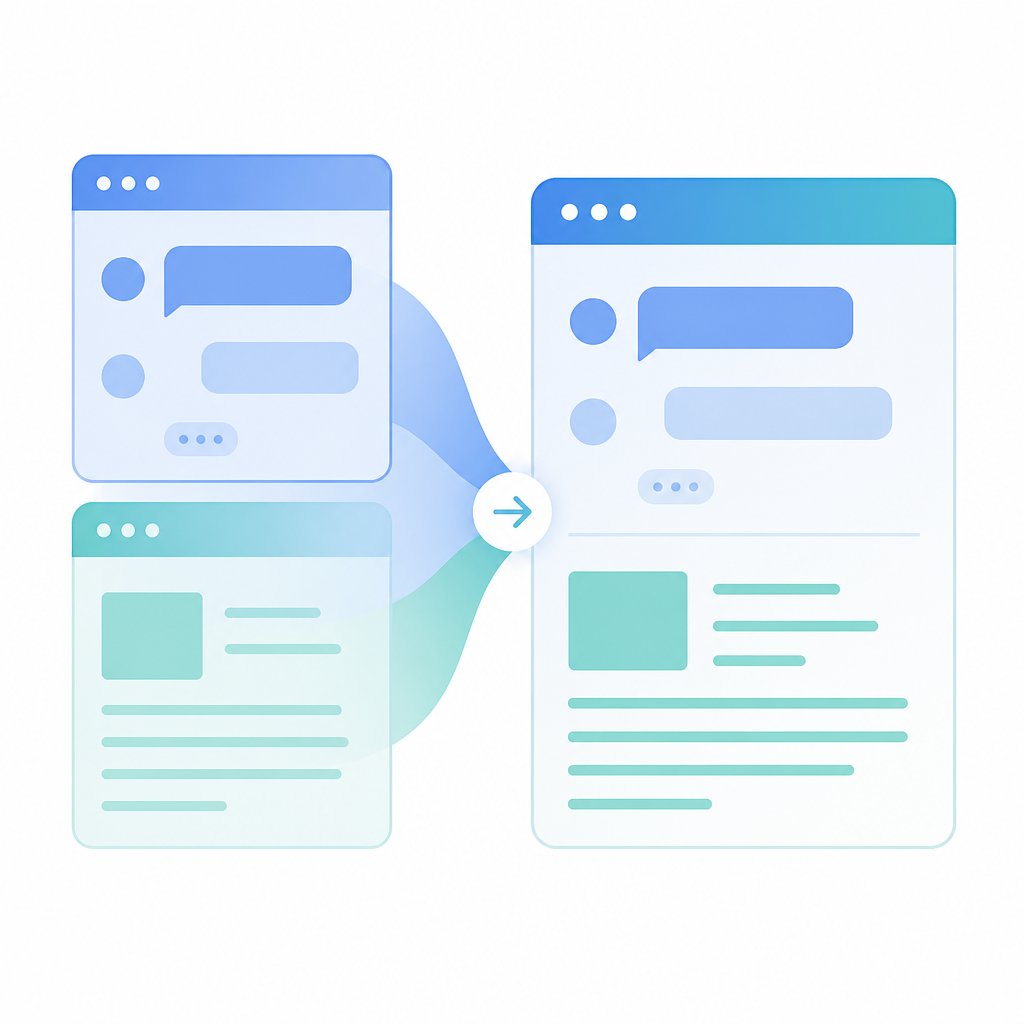
On September 16, 2026, Anthropic announced it is merging Claude Chat and Claude Cowork into a single interface, while also adding full document (Docs) and presentation (Slides) tools directly inside Claude. Until now, users had to decide upfront: open one product for a conversation with the model, switch to another to hand an agent a multi-step task involving files. Now, according to the company, "Claude automatically routes requests without having to switch tabs or windows" — the system itself determines which mode a given request needs. Pro and Max subscribers get the update first, on web, desktop and mobile; free and team tiers will follow later.
The admission that's more interesting than the release itself
On the surface, this is a routine interface update. But buried in Anthropic's own reasoning is a detail that says more than the feature list: the company that designed both modes is admitting that the split between "chat" and "Cowork" was confusing users. If the people who built both versions couldn't clearly explain to the market when to open which one, that's a symptom of a bigger problem. Over the past two years, businesses have quietly accumulated separate subscriptions for an AI chat, an AI task agent, an AI document editor and an AI presentation generator — often from the same vendor, but sold as distinct products with distinct interfaces and distinct invoices. Claude and Cowork merging isn't an isolated event; it's the first visible sign that the AI tools market is entering the consolidation phase familiar from the history of work software: first dozens of narrow point solutions, then integration into platforms — exactly what happened with email and calendars, with task trackers, with CRM.
What this changes tomorrow morning for a small business owner
Picture a five-person marketing agency currently juggling three open tabs: Claude Chat for quick questions and text drafts, Cowork so an agent can pull a report together from several client files, and a separate editor to turn that report into a client presentation. Every switch costs more than a minute or two — it breaks context: the agent in Cowork has to be told again what was already discussed in chat. If a unified interface genuinely removes that friction, the savings aren't measured in money but in how many times a small team has to re-explain a task to the AI — which is exactly what eats the most time for teams automating their own routine work.
Other categories of work software have already walked this path. Email and calendars used to be separate products from separate vendors — buying them apart today is unthinkable. Video calls were their own category until messaging apps folded them in. In each of these transitions, some businesses paid for a dedicated point solution right before that feature became a built-in — and often free, or nearly free — part of a tool they already used. AI tools are moving through the same stage faster than previous software categories did: the clock runs in quarters now, not years, which is worth remembering before signing an annual contract with a narrow AI point solution.
There's also reason for caution. The track record of similar interface mergers in other SaaS products — from email clients to task trackers — shows that the announcement and the actual seamlessness rarely arrive together. The first weeks after a merger typically bring duplicated features, confusion about where old links and settings went, and a gradual rather than instant rollout of everything that was promised. Here that's compounded by the tiered rollout: a business on the free or team plan won't see the unified interface right away, and the announcement gives no exact date — only "over the coming weeks." A company that has already built its processes around separate Chat and Cowork tabs should plan for a transition period, not an instant switch.
For a business, the main practical takeaway isn't that "Claude is now more convenient" — it's that the underlying trend, consolidating scattered AI tools into one working environment, shrinks the value of paying for a narrow, single-purpose AI subscription if the same functionality is about to show up inside a tool the business already pays for. Before adding yet another standalone AI service for one specific task, it's worth waiting a week or two to check whether an update to something already being paid for will solve it instead. That's how we at Dayava pick automations for clients — not by multiplying tools, but by building AI into what the business already uses.
If you'd like a similar solution for your business, get in touch at dayava.pt/contactos/.
Source: TechCrunch, "Anthropic merges Claude chat and Cowork in one interface"